
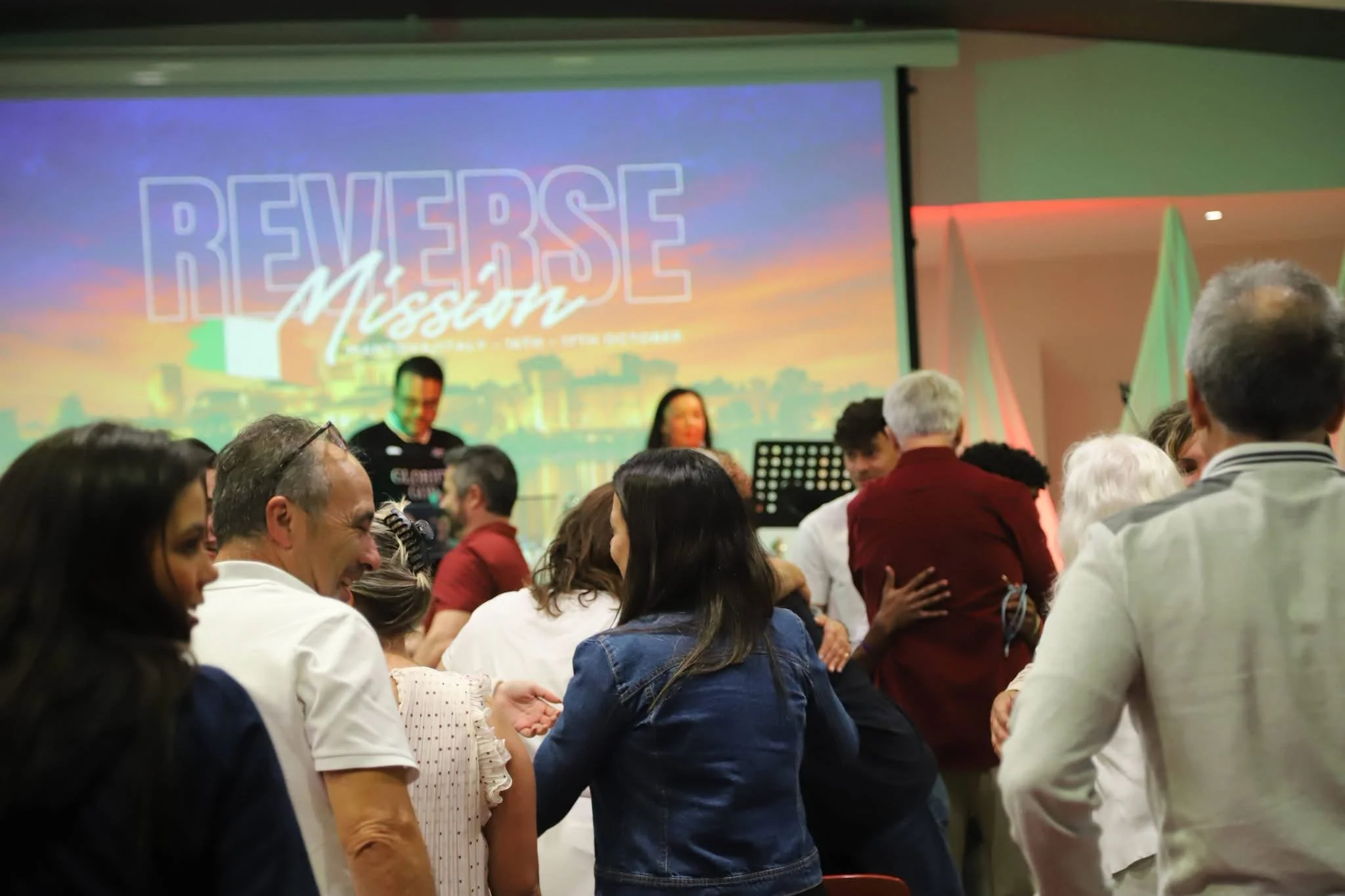
I recently returned from a Reverse Mission conference in Mantova, Italy, alongside 18 members of my New England church and fellow New England pastor and reverse missionary, Lierte Soares. There I witnessed a powerful, mature strategy for reaching Europe with the gospel.
For centuries, the missionary movement flowed in one direction: from the West to the Rest. Today, that movement flows both ways. Believers from Africa, South America, and Asia are relocating to Europe and North America, bringing a vibrant faith into nations where churches have grown cold. This movement, often called reverse missions, is anchored in a few vital principles.
Minister in the Language of the Land
A church that aims to reach Italy must speak Italian. One that aims to reach Germany must speak German. One that aims to reach the UK or Ireland must speak English. For many immigrant pastors, mastering a local language means immense labor and devotion, but it marks the boundary line between remaining an immigrant enclave and becoming a native church.
Preaching conducted in the local tongue opens the church's doors to the neighborhood. Grazie comes across very differently in Italy than thanks or obrigado! Some churches are working on this transition, with two services, one in the country’s language and the other in an immigrant language. Even still, the goal is to eventually become native.
Embrace Diversity as a Biblical Value
Reverse mission churches are places where immigrants and native-born citizens are welcomed in genuine fellowship. Diversity is a foundational good of God's design. The Book of Revelation depicts a vast multitude "from every nation, tribe, people, and language" standing before the throne (Revelation 7:9). Likewise, the church at Antioch, the launching pad for early missionary journeys, was led by a diverse group spanning Africa, Asia Minor, and Judea (Acts 13:1).
When a local congregation reflects this Christ-centered unity, it sends a message the surrounding culture cannot ignore. In such a time as this, marked by division and suspicion towards migrants, a community where the immigrant and the native commune as family at one table demonstrates the power of the gospel.
Love the Nation as Your New Home
A reverse missionary does not cross borders merely to take, whether greater creature comforts or economic advancement. They go to give. That commitment requires genuine love for the culture: learning its history, honoring its traditions, eating its food, and grieving its spiritual poverty.
In Italy, a reverse missionary becomes Italian; in Germany, German; in Ireland, an Irishman. This does not require rejecting one's ethnic heritage, but it does mean adopting the host nation as your new residency. You are not passing through; you are home.
Build Local Churches That Reach the World
Reverse mission is not about promoting missions agencies or launching new programs, it is about planting and strengthening local churches. The local congregation remains God's primary vehicle for mission: a congregation that worships, makes disciples, and sends.
A healthy church never operates as an island. Reverse mission churches remain intentionally linked to the global body of Christ, sharing resources, prayers, and friendship. That is the value of the Reverse Mission conference: it links pastors to pastors and churches to churches. For example, while in Italy I preached twice at an Italian church. In a couple of weeks, the Italian pastor will be in New England preaching at my church.
A Mission That Starts at Home
As the conference wrapped up, Italian songs still in our heads (Santo, santo, Dio potente), my church team was awestruck. We witnessed something that felt like a taste of heaven. Nations worshiping together, separated by languages yet still somehow united, and embracing each other as family. Tears filled many eyes as we said good-bye. Many testified, “This has been life changing.” That is reverse mission.